For teams and workforce programs

Build the judgment to read and question code.

Underneath the Syntax helps technical-adjacent learners trace program behavior, identify assumptions, examine error paths, and communicate more precisely with engineering teams without requiring a full software-development curriculum.

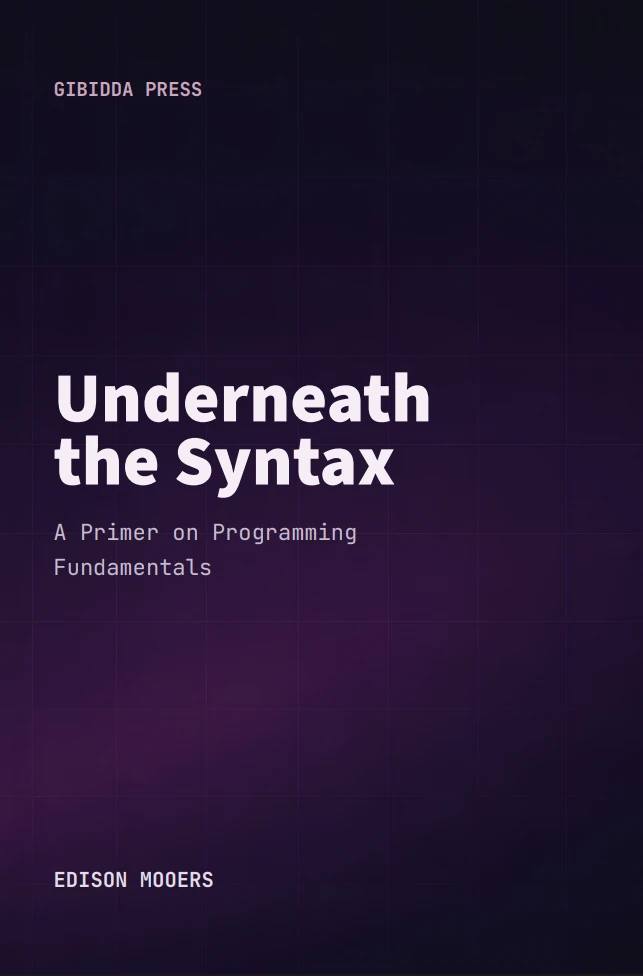
Cover of Underneath the Syntax: A Primer on Programming Fundamentals

The practical need

More people work around code than write it.

Testers, analysts, support teams, implementation specialists, managers, and workforce learners increasingly encounter scripts, automations, application logic, and AI-generated code. They may not need a full engineering curriculum, but they do need a reliable mental model of how programs store data, make decisions, repeat work, call functions, and fail.

The book provides that shared foundation in plain English. It can help a technical-adjacent learner explain unfamiliar code, ask more specific questions, and recognize where assumptions or missing error handling deserve closer review.

Who may benefit

Code literacy for roles beside and around engineering.

The most useful audience is not defined by job title alone. It is anyone who needs to understand what software is doing well enough to question, test, explain, or manage it.

QA and software testing

Trace execution flow, inspect conditions, identify edge cases, and understand error paths in code someone else wrote.

Product and business analysis

Translate requirements into software behavior that can be examined, discussed, and verified more precisely.

Technical support and implementation

Reason about workflows, inputs, state, logs, and failure paths to improve triage and communication.

Managers, L&D, and workforce programs

Build a shared vocabulary for AI-assisted and software-adjacent work without treating every participant as an aspiring developer.

Reasonable learning outcomes

What participants should become better able to do.

The goal is stronger understanding and judgment, not an inflated promise of instant programming expertise.

01

Trace the basic flow of a short program.

02

Identify variables, stored data, conditions, loops, and function boundaries.

03

Recognize assumptions about inputs and missing error handling.

04

Test or propose basic edge cases.

05

Explain unfamiliar code in plain English.

06

Ask developers or AI systems more precise questions.

Ways to use it now

Start with the book and existing resources.

No live workshop or custom engagement is required to make practical use of the material.

Team reading group

Use selected chapters as a shared vocabulary for discussing program flow, data, errors, and AI-generated code.

Internally facilitated cohort

Pair the book with the free browser companion and public worksheets, led by an internal trainer, engineering partner, or learning lead.

Institutional book order

Discuss larger cohorts, workforce programs, libraries, or team orders with Gibidda Press on an individual basis.

Future possibilities

Guided offerings remain a future possibility.

Gibidda Press may explore limited team, QA, or workforce learning options in the future. At present, there is no published workshop schedule, standard package, group-size promise, pricing structure, or delivery commitment.

Organizations are still welcome to describe their roles, goals, cohort size, and timing. That conversation can clarify whether the book and existing materials are a useful fit, whether an internally led pilot makes sense, or whether a future guided offering should be considered.

Teams and programs FAQ

What the current offering does and does not include.

Is this only for software engineers?

No. The book is particularly relevant to testers, analysts, technical support staff, managers, workforce learners, and others who need to reason about software behavior without becoming full-time developers.

Does it teach a specific programming language?

No. The book explains transferable programming concepts using language-neutral pseudocode. The free QF Code companion provides runnable practice.

Can a team use the materials without a live workshop?

Yes. A team can use the book, public resources, and companion in an internally facilitated reading group or learning cohort.

Are formal workshops currently available?

Gibidda Press is exploring limited team and workforce learning options, but no fixed workshop catalog, schedule, or standard delivery commitment is currently published.

Can we discuss a pilot or institutional order?

Yes. Share the roles involved, approximate cohort size, goals, and timing. The inquiry will be reviewed individually without assuming a particular service or package.

Does the book eliminate risk from AI-generated code?

No. It builds conceptual judgment that can support better review and questioning, but it does not replace engineering review, security testing, quality controls, or compliance processes.

Next step

Tell us what your people need to understand.

Share the roles involved, approximate cohort size, goals, and timing. The inquiry will be considered without assuming that a particular workshop or service already exists.