For high school, college, and workforce educators

A fundamentals-first bridge into any programming language.

Help learners understand what code is doing before syntax becomes the obstacle. Underneath the Syntax is a language-neutral supplemental resource with a free browser companion and a practical educator package.

Designed as a flexible supplement, not a replacement for your current curriculum.

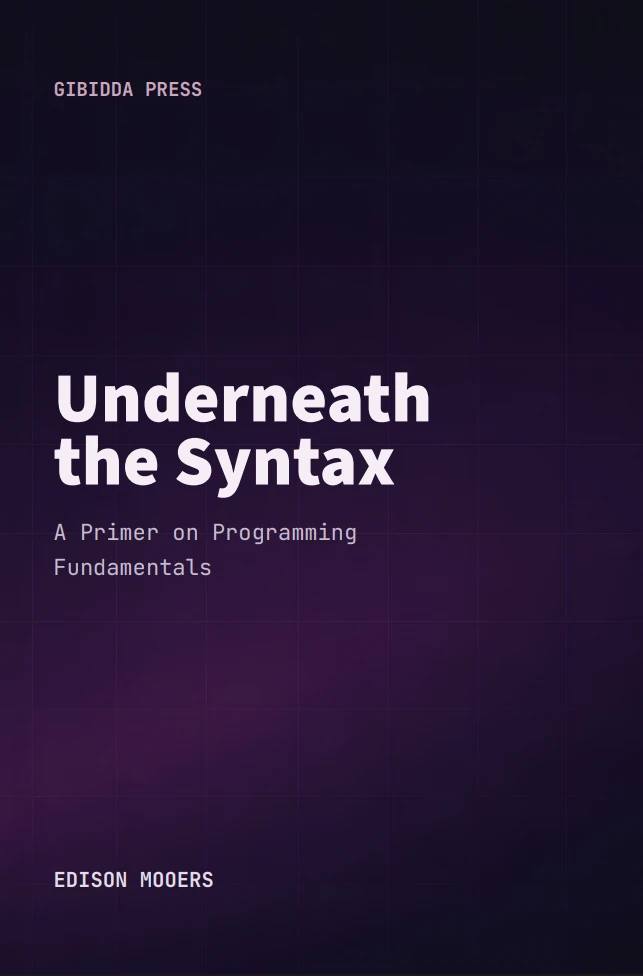
Cover of Underneath the Syntax: A Primer on Programming Fundamentals

The instructional problem

Syntax often arrives before understanding.

New learners are frequently introduced to language syntax, frameworks, packages, and AI-generated code before they have a stable mental model of programs, data, control flow, functions, memory, and errors. That can make normal beginner confusion feel like evidence that they are not capable of programming.

Underneath the Syntax slows that sequence down. It explains the transferable concepts first, using readable, language-neutral pseudocode, then lets students practice the same ideas in the free QF Code companion.

Where it fits

Adaptable across learner levels and program types.

The book can be assigned in full or scoped to the chapters that fit the time and goals of a particular course.

High school and CTE

Introductory computer science, AP Computer Science Principles support, robotics or coding clubs, career pathways, summer bridge, and enrichment.

Community college

CS0, introductory programming, early CS1 leveling, pre-course bridge work, tutoring centers, and IT, cybersecurity, or data programs.

Four-year college

First-year computing seminars, introductory IT or non-major courses, student-success programs, and optional confidence-building support.

Workforce and bootcamp preparation

Adult education, career-transition programs, bootcamp prework, QA and testing instruction, and technical-adjacent training.

Public educator materials

Review the teaching approach before requesting anything.

These PDFs are openly available. They show the structure, pacing, activities, worksheets, and assessment style included with the educator offering.

PDF · about 96 KB

Educator one-sheet

A concise overview of the book, where it fits, what makes it different, and what the educator package contains.

Download one-sheet

PDF · about 243 KB

Instructor Guide

Course outcomes, chapter tiers, pacing options, chapter-level objectives, discussion questions, activities, AI-code-literacy work, and capstone guidance.

Download Instructor Guide

PDF · about 139 KB

Printable Worksheets

Eight standalone student handouts for tracing, conditionals, loops, references, recursion, collections, capstone planning, and AI-generated-code review.

Download worksheets

PDF · about 61 KB

Chapter 1 quiz preview

A public preview of the question format used in the instructor-only Quiz and Exercise Bank.

Download quiz preview

Implementation options

Use the full arc or select the load-bearing chapters.

The Instructor Guide is built around real time constraints rather than assuming every course can assign all 26 chapters.

Full semester

Use the complete book across 14 to 16 weeks, with the final one or two weeks reserved for the capstone.

Condensed module

Use the sample six- to eight-week structure to cover Part I, selected deeper topics, AI-code literacy, and the capstone.

Self-paced or flipped support

Assign chapters and reading checks outside class, then use class time for discussion, worksheets, and companion practice.

AI-code literacy

Learners can generate code before they can evaluate it.

The educator materials include an AI-generated-code review checklist and activities that ask students to identify variables, conditions, loops, parameters, return values, assumptions, missing error handling, and untested edge cases.

The point is not to reject AI tools. It is to build enough understanding that a learner can inspect the result, explain it independently, and ask better questions when something is unclear or wrong.

Available by request

Evaluation and instructor-only materials.

Educators and program leaders considering adoption may request a complimentary digital evaluation copy. Requests are reviewed individually. Print copies may be available selectively at the discretion of Gibidda Press.

The complete Quiz and Exercise Bank and the separate instructor answer key are also request-only so the assessment material remains useful. Limited virtual author Q&A sessions may be available for selected pilots or classroom adoptions, subject to scheduling.

When contacting the Press, include your role, institution or organization, course or program, learner level, approximate enrollment, intended term, and the materials you would like to review.

Educator FAQ

Practical questions before adoption.

Is this a replacement textbook?

No. It is designed as a flexible supplement that builds a conceptual foundation before or alongside a language-specific course.

Can I use only selected chapters?

Yes. The Instructor Guide labels chapters Core, Recommended, or Extension and includes full-semester, condensed, and self-paced approaches.

May I copy the worksheets for learners?

Yes. Educators may reproduce and distribute the worksheets to learners in educational settings they directly lead, including paid bootcamps and employer-run training. The collection may not be resold or reposted publicly as a complete set.

Does the companion require installation or an account?

No. The QF Code companion runs in a browser and does not require an account or installation.

Is a full evaluation copy available?

Educators and program leaders considering adoption may request a complimentary digital evaluation copy. Requests are reviewed individually. Print copies may be available selectively at the discretion of Gibidda Press.

Can Edison join a class virtually?

Limited virtual author Q&A sessions may be available for selected pilots or classroom adoptions, subject to scheduling.

Are the complete quiz bank and answer key public downloads?

No. A Chapter 1 preview is public. The complete instructor question bank and separate answer key are available by request so they remain useful for assessment.

Next step

Review the public materials, then tell us about your course or program.

Requests are reviewed individually so the materials and next step can match the actual educational use.